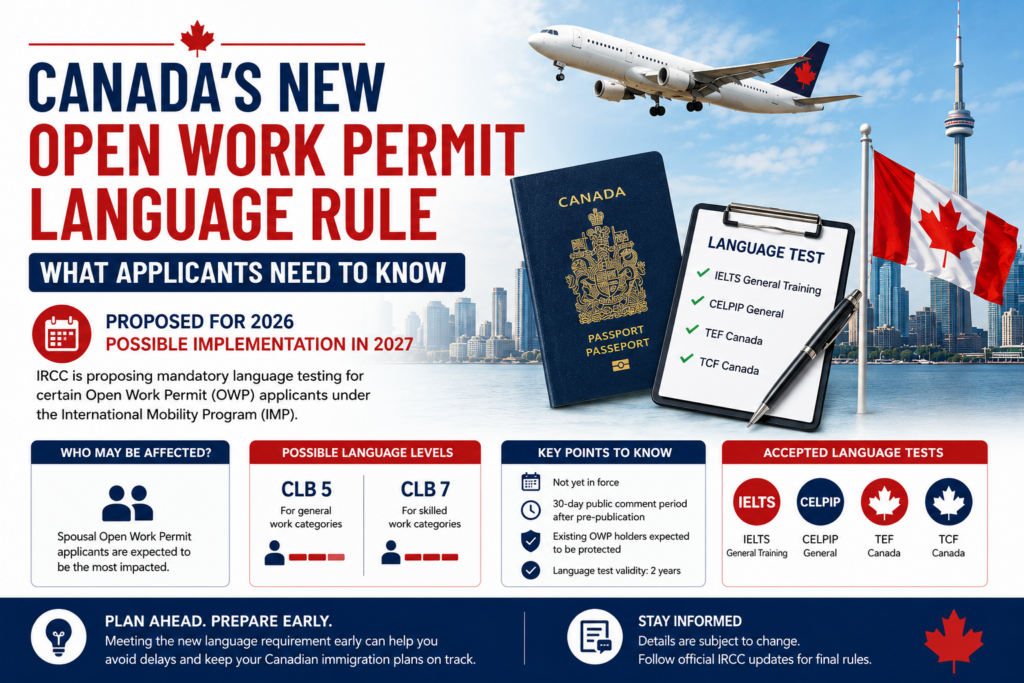
Canada is preparing for another major immigration policy shift that could affect thousands of temporary residents and their families. Immigration, Refugees and Citizenship Canada (IRCC) is moving closer to introducing mandatory language testing requirements for certain Open Work Permit (OWP) applicants under the International Mobility Program (IMP).
The proposal, currently listed in IRCC’s Forward Regulatory Plan, is expected to move toward formal publication in 2026, with possible implementation beginning in 2027.
One of the most impacted categories is expected to be Spousal Open Work Permits (SOWP), making this an important development for international students, foreign workers, and families planning their future in Canada.
Key Highlights of the Proposed Rule
Here are the major updates applicants should know:
-
- The proposal is NOT currently in force
-
- No language test is required at this time for most Open Work Permit categories
-
- Earliest implementation is expected in 2027
-
- A public consultation period is expected before final approval
-
- Spousal Open Work Permit applicants may become the largest affected group
-
- Expected language benchmarks may include:
-
- CLB/NCLC 5 for general work categories
-
- CLB/NCLC 7 for skilled occupations
-
- Expected language benchmarks may include:
-
- Likely accepted language tests:
-
- IELTS General Training
-
- CELPIP General
-
- TEF Canada
-
- TCF Canada
-
- Likely accepted language tests:
-
- Language test results will likely remain valid for 2 years
-
- Existing valid Open Work Permit holders may receive protection under transitional or grandfathering rules
Although final details are still pending, the proposed structure appears similar to Canada’s current Post-Graduation Work Permit (PGWP) language framework introduced in 2024.
What Is the International Mobility Program (IMP)?
The International Mobility Program (IMP) covers LMIA-exempt work permits and includes several major immigration streams such as:
-
- Spousal Open Work Permits (SOWP)
-
- Post-Graduation Work Permits (PGWP)
-
- Bridging Open Work Permits (BOWP)
-
- International Experience Canada (IEC)
-
- Intra-company transfers
-
- Free trade agreement work permits
-
- Reciprocal employment programs
Canada has also announced reduced temporary resident targets for upcoming years, showing a stronger focus on labour market alignment and long-term economic integration.
Why Spousal Open Work Permits Are Expected to Be Most Affected
Spousal Open Work Permits have already become more restricted in recent years.
Current eligibility rules limit many SOWP applications to spouses or common-law partners of workers employed in:
-
- TEER 0 occupations
-
- TEER 1 occupations
-
- Selected TEER 2 and TEER 3 occupations
The proposed language requirement could become an additional eligibility layer on top of existing TEER-based restrictions.
Canada’s immigration system is increasingly prioritizing:
-
- Labour market integration
-
- Language proficiency
-
- Skilled employment pathways
-
- Transition from temporary residence to permanent residence
Strong language ability is now viewed as a key factor for long-term success in Canada’s workforce and immigration system.
Expected Language Benchmarks
While official thresholds have not yet been finalized, immigration experts expect two likely levels:
CLB 5
May apply to:
-
- General Open Work Permit categories
-
- Lower or mid-skilled work streams
-
- Certain spousal permit categories
CLB 7
May apply to:
-
- Skilled occupations
-
- PR-focused immigration pathways
-
- Higher-skilled work categories
This structure closely mirrors Canada’s existing PGWP language rules.
IELTS General Reference for CLB Levels
CLB 5 Equivalent
-
- Listening: 5.0
-
- Reading: 4.0
-
- Writing: 5.0
-
- Speaking: 5.0
CLB 7 Equivalent
-
- Listening: 6.0
-
- Reading: 6.0
-
- Writing: 6.0
-
- Speaking: 6.0
Applicants considering future permanent residency pathways may benefit from targeting CLB 7 whenever possible.
What This Could Mean for Different Applicants
Existing Open Work Permit Holders
Applicants who already hold valid Open Work Permits may not be immediately impacted. However, future extensions or renewals after implementation could require language test results.
Planning ahead is strongly recommended.
Spouses of PGWP Holders
This category may see major changes.
If the principal applicant works in an eligible TEER occupation, spouses may still qualify for an Open Work Permit, but language testing could become mandatory beginning in 2027.
Taking a language test early could help avoid future delays.
Spouses of Foreign Workers
Applicants may need to satisfy:
-
- Existing TEER eligibility rules
-
- Proposed future language requirements
If the principal applicant’s occupation falls outside eligible TEER categories, a Spousal Open Work Permit may already be unavailable.
Spouses of International Students
Spousal Open Work Permits for international students have already been restricted to selected programs in recent years.
The proposed language rule may become an additional requirement for eligible spouses.
Bridging Open Work Permit Applicants
The impact on Bridging Open Work Permit (BOWP) applicants remains unclear.
Because many permanent residence applicants already submit language scores through Express Entry or provincial pathways, the practical impact may be smaller for this category.
Further clarification is expected once the official regulatory text is published.
Strategic Steps Applicants Should Consider
1. Book Language Tests Early
Demand for IELTS and CELPIP exams continues to increase globally.
Applicants should consider preparing for:
-
- IELTS General Training
-
- CELPIP General
-
- TEF Canada
-
- TCF Canada
Avoid IELTS Academic unless specifically required.
2. Aim Beyond the Minimum Score
Although CLB 5 may become the minimum requirement for some categories, CLB 7 offers stronger long-term immigration flexibility and supports future permanent residence applications.
3. Apply Before Future Changes Take Effect
Applicants who are already eligible for Open Work Permits may benefit from applying before implementation begins.
Early applications could help avoid additional future requirements.
4. Confirm TEER Eligibility
Language scores alone may not guarantee eligibility.
Applicants should first verify whether the principal applicant’s occupation falls within eligible TEER categories.
5. Follow Official Immigration Updates
Several details remain unconfirmed, including:
-
- Exact affected categories
-
- Final CLB thresholds
-
- Exemptions
-
- Transition rules
-
- Treatment of applications already in process
Applicants should continue monitoring official IRCC announcements and regulatory updates.
Canada’s Broader Immigration Shift
The proposed Open Work Permit language rule reflects a broader restructuring of Canada’s temporary immigration system.
Recent changes already include:
-
- Reduced temporary resident targets
-
- PGWP language requirements
-
- TEER-based Spousal Open Work Permit restrictions
-
- Greater focus on economic integration
Overall, Canada’s immigration pathways are becoming more:
-
- Language-focused
-
- Occupation-driven
-
- Selective
-
- PR-oriented
Applicants who prepare early and build strong immigration profiles will likely have the best outcomes.
How Mount Fox Immigration Consulting Can Help
Mount Fox Immigration Consulting provides personalized immigration guidance for individuals and families navigating Canada’s evolving work permit and immigration system.
Their services include support for:
-
- Spousal Open Work Permits (SOWP)
-
- Post-Graduation Work Permits (PGWP)
-
- Work permit extensions
-
- Study permits
-
- Express Entry applications
-
- Visitor visas
-
- Permanent residency pathways
-
- LMIA and employer-based immigration options
Whether you are planning to study, work, reunite with family, or transition toward permanent residence in Canada, professional immigration guidance can help simplify the process and reduce unnecessary risks.
Final Thoughts
Canada’s proposed Open Work Permit language requirement could become one of the most important immigration policy changes affecting temporary residents and families in 2026–2027.
Although the regulation has not yet been finalized, applicants should begin preparing now by:
-
- Understanding TEER eligibility
-
- Planning language testing timelines
-
- Monitoring official IRCC updates
-
- Building stronger long-term immigration strategies
Early preparation can help reduce delays, improve application readiness, and create smoother pathways toward future immigration opportunities in Canada.