Bringing your husband, wife, or partner to Canada isn’t like applying for Express Entry or a study permit. You aren’t fighting for points on a grid, nobody cares about your college GPA, and you don’t need an LMIA work permit from an employer.
Instead, the whole application hinges on one single reality: convince an immigration officer that you two actually love each other and didn’t just get married for a Canadian PR card.
It sounds simple enough on paper. But once you open the IRCC portal and stare at fifty pages of empty forms, panic usually sets in. How many WhatsApp messages do you actually need to print? What happens if you took a trip apart for three weeks? What if you don’t make a six-figure salary?
Here is the straightforward truth about sponsoring a partner to Canada through spousal sponsorship canada immigration, how to assemble a package that doesn’t get kicked back, and the small mistakes that leave couples waiting for years.
First Things First: Who Can Actually Sponsor?
Before you spend three days sorting out old photos and bank records, make sure you don’t trip over the basic ground rules. Most Canadian couples qualify without issues, but a couple of hidden catches trip people up.
If you are the Canadian sponsor:
- You have to be at least 18 years old.
- You need to be a Canadian citizen, a Permanent Resident, or registered under the Indian Act.
- Watch where you live: A Canadian citizen can legally apply while living abroad with their partner, provided they show solid plans to relocate back to Canada once the visa clears. If you’re a PR, though, you don’t get that pass. You must physically reside inside Canada when you hit submit and stay there while the application processes.
- You cannot be on government welfare (disability assistance is fine, regular social assistance is not).
- You cannot have sponsored another partner to Canada within the last five years.
One massive relief for most folks: there is no minimum income requirement to sponsor your partner. You don’t need to show fifty grand sitting in a savings account. As long as you aren’t bankrupt or drawing social assistance, IRCC doesn’t set an income bar (unless your spouse brings along dependent kids who have their own kids).
Married vs. Common-Law vs. Conjugal
How IRCC defines your partnership matters a lot for your checklist:
- Legally Married: You had an official wedding, signed a registry, and have a government marriage certificate. If you married overseas, it just needs to be legally valid under that country’s laws and recognized by Canadian federal law.
- Common-Law: You haven’t had a legal ceremony, but you have lived under the same roof in a committed, marriage-like relationship for a continuous 12 months. IRCC will want hard proof for every single one of those 365 days—shared leases, utility bills, mail with matching addresses.
- Conjugal: You’ve been together for over a year, but immigration bans, local laws criminalizing same-sex relationships, or genuine legal roadblocks made living together or marrying impossible. IRCC scrutinizes this heavily; you can’t use conjugal just because it was inconvenient to move.
The Big Strategic Fork: Inland vs. Outland
You have to pick between two different spousal sponsorship canada processing time streams, and this decision completely shapes your day-to-day life over the coming year.
Inland (Spouse in Canada Class)
Pick this if your partner is already inside Canada on a visitor record, work permit, or study visa, and you both live together right now.
- The good part: Once you get your Acknowledgement of Receipt (AOR), your partner can apply for an open work permit (SOWP) so they can work legally while waiting.
- The dangerous part: Leaving Canada while your file is processing is a massive gamble. If your spouse takes a short trip home and a border officer at the airport refuses to let them back in, the Inland application is killed on the spot. No appeal.
Outland (Family Class)
Pick this if your partner is living abroad, or even if they’re in Canada but need to travel internationally for work, weddings, or family visits.
- The good part: Your partner can travel across borders without jeopardizing the file. If an officer makes a bad call and rejects your case, you have full appeal rights to the Immigration Appeal Division (IAD).
- The downside: Outland speed varies wildly depending on the workload of the local Canadian embassy processing your partner’s background checks.
What Genuine Proof Actually Looks Like
Immigration officers look through thousands of spousal files every year. They can smell a fabricated relationship within five minutes.
You don’t need a 400-page binder of every mundane conversation you had on Telegram. What officers want is a consistent, clear picture of a shared life.
Focus your proof around these core areas:
- Where your mail goes: Leases signed by both of you, joint home purchases, hydro and internet bills with both your names, or government IDs listing the same street address. For common-law, this is life or death for your file.
- How you handle daily money: A joint checking account you actually use to buy groceries and pay rent, credit card statements showing shared spending, or naming each other as beneficiaries on workplace insurance or pension funds.
- What friends and family see: Don’t just dump twenty photos from your wedding day. Pick 15 to 25 photos spread out over different years, holidays, vacations, and family dinners. Write a brief caption on each: date, location, and who is in the picture. Include plane boarding passes from trips you took together and invitations to family events.
- Staying in touch during distance: If you had to spend months living apart, grab a small, tidy sample of call logs, FaceTime histories, and chat messages showing steady contact across that time.
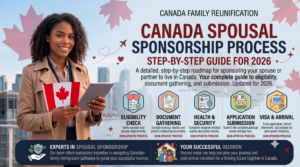
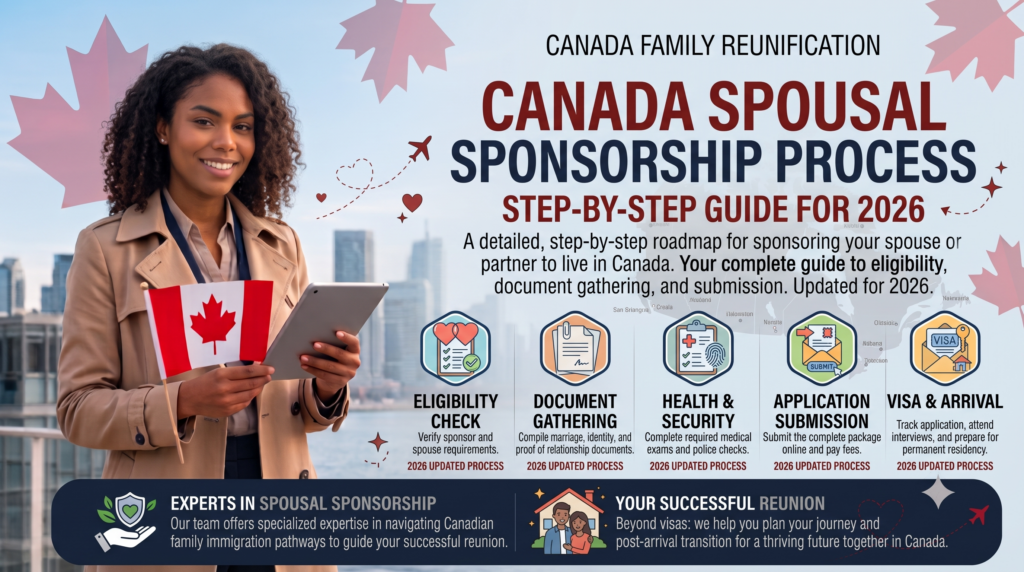
Filing the Application: Step by Step
Everything goes through the IRCC Permanent Residence Portal online now—paper applications are pretty much ancient history.
- Fill the web forms: The sponsor tackles the spousal sponsorship canada assessment and financial evaluation. The applicant fills out their personal background, travel logs, and family history.
- The 3-Year Undertaking: Don’t skim past this part. By signing the sponsorship agreement, the Canadian partner legally agrees to support the incoming spouse financially for three full years starting the day they become a PR. Even if you break up, fight, or get divorced six months later, you remain legally on the hook for any social assistance they collect during those three years.
- Pay the fees: For a standard spouse without children, it runs to $1,290 CAD (sponsorship fee, processing fee, Right of Permanent Residence fee, and biometrics).
- Upload and wait for your AOR: Once submitted, IRCC does an initial check to make sure no forms are blank. If everything looks complete, they email you an Acknowledgement of Receipt (AOR) in roughly 4 to 8 weeks, giving you the official file number to track online.
What Comes After the AOR?
Once your file starts rolling, IRCC will trigger three requests:
- Biometrics: Your spouse gets a letter directing them to an authorized VAC center or Service Canada office to submit fingerprints and take a photo.
- Medical Exam: Don’t rush to take a medical beforehand. Wait until IRCC issues an official request letter with your IME number, then book with an approved Panel Physician.
- Police Clearances: You must submit original police certificates for any country where the foreign partner lived for six months or longer after turning 18.
- Final Approval: If applying Inland, your partner gets their electronic Confirmation of Permanent Residence (eCoPR) right in the portal. If Outland, they mail their passport to get the PR counterfoil sticker and physical landing paper.
The Small Mistakes That Cause Months of Delays
- Unexplained calendar gaps: Schedule A asks for your history since age 18. If you finished school in May and started work in August, don’t leave those two months blank. Write “unemployed / looking for work.” A tiny gap triggers a delay letter every time.
- Translations done by friends: If your birth certificate or marriage registry isn’t in English or French, you need a certified translation accompanied by an official translator’s affidavit. A handwritten note won’t fly.
- Inconsistent relationship dates: If your cover letter says you moved in together on June 1st, but your joint lease starts on July 15th, an officer is going to stop and question your story. Ensure dates match across every form, letter, and photo caption.
Practical Questions
Can my spouse work while we wait for an answer?
If they are living in Canada on a valid visitor or student visa and you apply through the Inland route, yes. Once you get that AOR email, they can submit an application for an open work permit.
Does my ex lose PR if we split up after approval?
No. Once PR is granted, it belongs to them. But remember: your legal responsibility under the three-year financial undertaking doesn’t disappear when a relationship ends.
Do we really need to hire a lawyer?
If your case is clean—no criminal history, no previous deportation orders, clear legal marriage or solid proof of living together—thousands of couples manage the application entirely on their own. But if you have messy past visa refusals, complicated custody situations, or struggle to prove a 12-month common-law timeline, having an RCIC or immigration lawyer review your stack before submitting is well worth the peace of mind.