Let’s be honest about the Express Entry system right now.
If you are an offshore applicant sitting with a Comprehensive Ranking System (CRS) score around 420 or 450, waiting for a general all-program federal draw is an exercise in frustration. The cut-off scores have stayed brutally high.
Unless you speak fluent French or happen to qualify for very specific STEM and healthcare category draws, your Express Entry profile is just going to sit in the pool collecting dust.
That is why most people who actually get their Permanent Residency (PR) today take the Provincial Nominee Program (PNP) route instead.
Landing a nomination hands you an instant 600 bonus points. That completely obliterates any CRS cut-off barrier and guarantees you an Invitation to Apply (ITA) in the next draw.
The catch? Every province in Canada treats immigration like its own private hiring desk. What gets you an invite in Calgary won’t work in Halifax, and what works in Toronto is entirely different from what Saskatchewan wants.
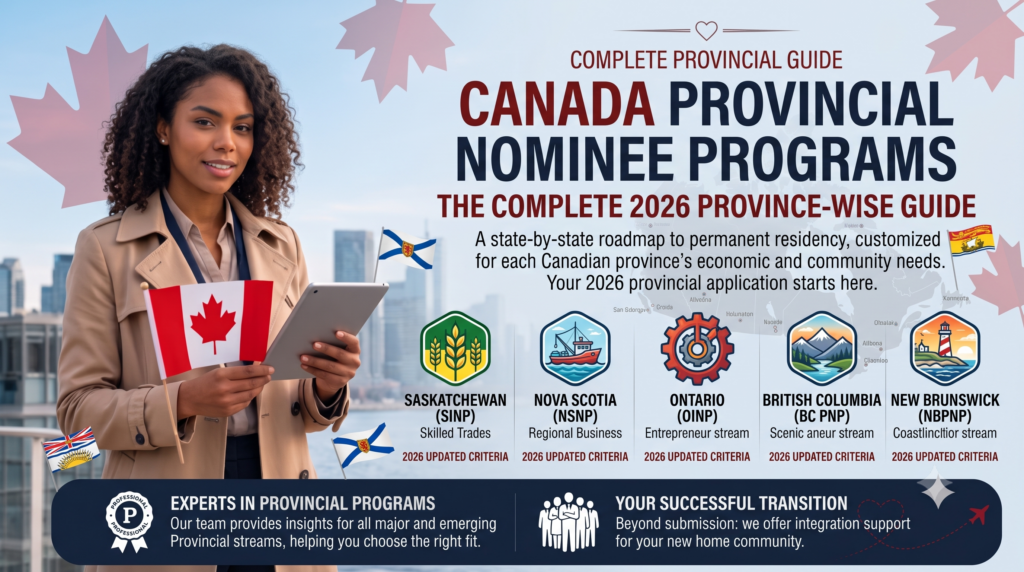
Here is a practical, no-nonsense look at how the main provincial programs operate, who they are actually picking, and how to build a realistic strategy around them.
Enhanced vs. Base PNPs: The First Distinction You Must Know
Before you start sending applications across Canada, make sure you understand the difference between the two tracks. Mix these up, and you could add an extra year to your timeline.
- Enhanced Streams (Linked to Express Entry): You create a standard federal Express Entry profile first. A province browses the pool, likes your background, and sends you a Notification of Interest (NOI). You accept, get 600 points added to your score, and IRCC processes your PR electronically—usually within six to eight months.
- Base Streams (Direct Non-Express Entry): You apply directly to a province’s own portal without touching Express Entry. If they approve you, you take that paper nomination certificate and file for PR through the non-Express Entry portal. It works, but it takes much longer (frequently 15 to 20 months). The upside? The language and education bars are usually much lower.
The Major Provinces: Who Are They Actually Looking For?
1. Ontario (OINP)
Ontario takes in the lion’s share of newcomers, but it is also the most competitive province in the country.
- Human Capital Priorities (HCP): This is the stream everyone talks about because you do not need a Canadian job offer. Ontario scans the Express Entry pool and invites candidates based on specific NOC codes—mostly tech workers (developers, data scientists), registered nurses, and skilled trades. Your CRS score still matters here; they usually set their own mini cut-off between 460 and 490.
- Employer Job Offer Streams: If you already have a full-time job offer from a registered Ontario business, this is your fastest path.
- Masters & PhD Streams: Graduated from an eligible Ontario university? You can register directly without needing a job offer lined up.
2. British Columbia (BC PNP)
BC runs its own internal points grid called SIRS (Skills Immigration Registration System). They rank you based on your hourly wage, work experience, education level, and where the job is located.
- Targeted Tech & Priority Draws: BC consistently pulls tech professionals across dozens of specific roles, along with early childhood educators (ECEs), construction supervisors, and healthcare workers.
- The Regional Advantage: If your job offer is in Greater Vancouver, you get fewer points on the grid. If your job offer is outside the Lower Mainland (places like Kelowna, Prince George, or Vancouver Island), BC awards massive location bonuses that make getting invited far easier.
3. Alberta (AAIP)
Alberta has become a magnet for applicants looking to escape the extreme housing costs in Ontario and BC. Plus, Alberta has no provincial sales tax.
- Alberta Express Entry Stream: This is one of the friendliest streams for lower CRS scores. Alberta frequently pulls profiles from the federal pool with scores as low as 300 to 360, provided your work history fits their current labor shortages (energy, agriculture, tourism, construction, and IT).
- Accelerated Tech Pathway: If you have a job offer from an eligible Alberta tech company, your nomination gets fast-tracked through a dedicated desk.
- Rural Renewal Stream: Small rural towns in Alberta have the power to recruit and endorse foreign workers directly for PR, bypassing big-city competition entirely.
4. Saskatchewan (SINP)
Saskatchewan remains a favorite for offshore applicants because it still offers legitimate pathways that require zero Canadian job offers.
- Occupations In-Demand & Express Entry: Saskatchewan uses an internal 100-point grid. If you score at least 60 points and your occupation isn’t on their excluded list, you can submit an Expression of Interest (EOI). When they run a draw for your profession, you get invited directly from your home country.
- Hard-to-Fill Skills Pilot: Built specifically for intermediate and entry-level positions (like food processing, transport truck driving, and warehouse work) that struggle to find local staff.
5. Manitoba (MPNP)
Manitoba is all about community connections. If you have close family in Winnipeg, you have a massive advantage.
- Skilled Workers Overseas: To get invited from abroad, you almost always need a strong “Manitoba Connection”—either a close relative living in the province, past education/work experience there, or an invite via an official overseas recruitment mission.
- Skilled Workers in Manitoba: If you are already working inside the province on a temporary work permit and have six months of local experience, your path to nomination is exceptionally straightforward.
6. The Atlantic Provinces (Nova Scotia, New Brunswick, PEI, Newfoundland)
The East Coast runs on lower population densities and desperate labor shortages.
Alongside their provincial nominee streams, all four provinces participate in the Atlantic Immigration Program (AIP). If you land a designated job offer here, language requirements drop down to CLB 4 or 5 for intermediate roles, and work experience criteria are much more forgiving than anywhere else in Canada.
How to Build a Working PNP Strategy
Don’t just sit back and hope an invite drops into your lap. You need to position yourself strategically:
- Keep your core paperwork updated: Make sure your language test (IELTS, CELPIP, or PTE Core) and Educational Credential Assessment (ECA) are not close to expiring. Provinces pull batches without warning; if your docs are expired, you miss the window.
- Look closely at targeted categories: General administrative and retail profiles face intense competition. If your background touches healthcare, education, trades, or niche engineering, target the provinces that run dedicated sub-category draws for those specific fields.
- Look outside the big two cities: Everyone wants to land in Toronto or Vancouver. The moment you look at mid-sized cities in Alberta, Saskatchewan, or Atlantic Canada, your chances of getting employer support and provincial backing jump dramatically.
- Be ready to prove your intent to settle: Provinces will reject your application if they think you are just using them for a nomination certificate and plan to move to Ontario the day you land. Show real connections, local research, and clear proof of settlement funds.
Real Answers to Common Questions
1. Can I get a PNP without any job offer in Canada?
Yes. Streams like Saskatchewan’s Occupations In-Demand, Ontario’s Human Capital Priorities, and Alberta’s Express Entry stream regularly pull candidates directly from the pool without demanding a local job offer.
2. Does a PNP guarantee PR approval?
The province approves your nomination, but IRCC makes the final legal decision on your Permanent Residency. As long as you pass medical checks, criminal background screenings, and have not misrepresented any work experience, federal approvals are standard.
3. Can I move to a different province right after getting PR through a PNP?
Canadian Permanent Residents have mobility rights under the Charter of Rights and Freedoms. However, when you apply for a PNP, you sign a formal legal declaration stating your intention to settle in that specific province. Leaving the province within weeks of landing without making a genuine effort to find work or settle down can raise red flags regarding misrepresentation during your future Canadian citizenship application.