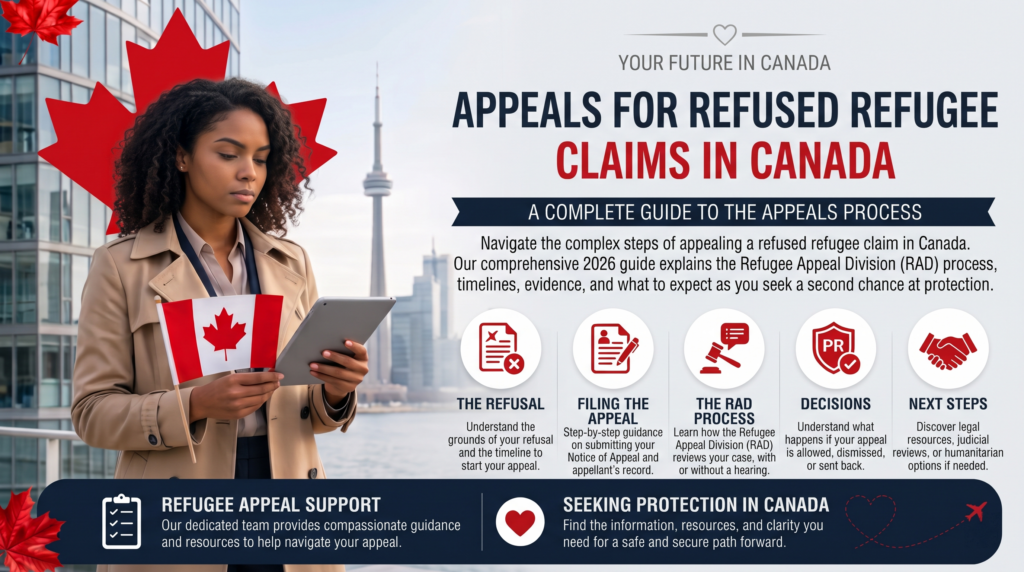
Opening a rejection notice from the Refugee Protection Division feels like the ground slipping out from beneath your feet. Refugee Claims You uproot everything—leave your hometown, step away from work, say goodbye to family—hoping Canada will give you a safe place to rebuild. Then an official paper arrives saying your claim was turned down. It’s completely normal to feel a sudden wave of panic about what happens next.
Fortunately, a refusal doesn’t mean border officers are immediately deporting you. Canada’s asylum system is undeniably strict, but it features layered review procedures designed to catch errors made by initial decision-makers. Before deciding on your next move, you need to understand why adjudicators say no and how the refugee appeal process in canada actually works.
Why Refugee Claims Get Turned Down
To build a valid legal challenge, your lawyer first has to tear apart the written decision. RPD members measure every narrative against complex domestic statutes and international refugee conventions.
When board members reject an application, it usually boils down to three legal barriers.
Credibility comes first. The member might claim your oral testimony had timeline gaps, felt scripted, or clashed with country condition documents.
State protection comes second. The tribunal might decide that even if bad things happened to you back home, the police or legal system in your native country could reasonably protect you if you asked for help.
An Internal Flight Alternative, or IFA, comes third. The adjudicator might agree that your hometown is dangerous, but argue you could safely move to a different city or region within your home country.
That written refusal spells out their exact legal arguments, making it the blueprint for your strategy moving forward.
The Refugee Appeal Division
For most applicants, the primary line of defense to appeal refugee decision canada is taking the case to the Refugee Appeal Division, known as the RAD.
Unlike your initial trial, you won’t testify in a live courtroom at the RAD stage. It operates almost entirely on written paperwork. Your legal representative drafts detailed briefs showing where the original member made mistakes—whether they misread documentary evidence, ignored vital testimony, or misapplied Canadian law.
The RAD can confirm the original rejection, throw out the ruling and grant refugee protection outright, or order a completely new hearing before a different board member.
Timing here is exceptionally tight. The statutory cutoffs to notify the tribunal and submit your complete appeal package are short. Missing these deadlines by even a single day can cause you to forfeit your right to appeal permanently. Furthermore, staying informed about the average refugee appeal processing time can help you and your legal representative manage expectations and prepare effectively throughout the waiting period.
Federal Court Judicial Review
If the RAD rejects your appeal—or if your initial claim category falls into an exception that skips the RAD—your next option inside Canada is seeking a Judicial Review at the Federal Court of Canada.
Judicial Review functions under entirely different rules than a tribunal appeal. A federal judge won’t re-hear your story or decide whether you need protection. Instead, the court evaluates procedural fairness and legal reasonableness. They determine whether the administrative body followed proper procedures and reached a defensible decision based on the evidence before them.
This process moves through two distinct steps. First, your lawyer must apply for permission, known as leave. You have to prove to a judge that the underlying decision contained a serious legal error. If leave is denied, the case ends immediately. If leave is granted, your lawyer appears before a judge to debate government attorneys face-to-face on whether the ruling was legally sound.
Backup Options and Emergency Safeguards
When formal court challenges run out, deportation fears become urgent. Still, depending on how much time has passed and how conditions have changed, a few administrative channels might remain available.
If significant time passes after a refusal, or if safety conditions in your home country sharply deteriorate, you may qualify for a Pre-Removal Risk Assessment (PRRA). Officers evaluate the real-time hazards you would face if returned today.
In select situations, individuals file applications based on Humanitarian and Compassionate grounds. These evaluate factors like deep community integration built within Canada, urgent medical necessities, or the best interests of affected children.
Additionally, if removal arrangements are actively being pushed through while legal challenges sit before the court, counsel can file an emergency motion for a stay of removal, asking a judge to temporarily freeze deportation until the legal dispute resolves.
Why Legal Strategy Matters
Refugee appeals involve rigid statutory deadlines, dense administrative procedures, and complex legal precedents. A minor technical mistake or poorly framed argument can jeopardize an otherwise strong case. Working alongside an experienced immigration lawyer who routinely handles tribunal litigation and Federal Court reviews gives you the strongest chance to protect your rights, challenge a bad decision, and fight for your future in Canada.
Frequently Asked Questions (FAQs)
1. How long do I have to file an appeal after my refugee claim is refused?
The deadlines for appealing to the Refugee Appeal Division (RAD) are extremely strict. You have 15 days from the date you receive the written reasons for the RPD’s negative decision to file your Notice of Appeal. Following that, you have 45 days from the date of receiving the decision to submit your completed Appellant’s Record (which includes your full written arguments and evidence).
2. What is the average refugee appeal processing time in Canada?
Under standard Immigration and Refugee Board (IRB) guidelines, the Refugee Appeal Division aims to make a decision within 90 days once an appeal is fully perfected (meaning all required documents are submitted). However, actual processing times can vary depending on caseload volume, case complexity, or whether an oral hearing is required. Overall waiting times generally range between 6 to 12 months.
3. Can every refused refugee claimant appeal to the RAD?
No, not all claimants are eligible to appeal to the Refugee Appeal Division. Exceptions include claims deemed “manifestly unfounded” or “with no credible basis,” claims heard by a single member under specific designated provisions, claims submitted under Safe Third Country agreements, or claims withdrawn or abandoned. If you fall into an excluded category, your primary option inside Canada is seeking Judicial Review at the Federal Court.
4. Can I submit new evidence during my refugee appeal process in Canada?
Yes, but under very limited circumstances. Under Section 110(4) of the Immigration and Refugee Protection Act (IRPA), the RAD will only accept new evidence if it arose after the original RPD decision, was not reasonably available at the time of the initial hearing, or is evidence that you could not reasonably have been expected to present at that time.
5. Will I be deported while my refugee appeal or judicial review is pending?
If you qualify for an appeal to the RAD, an automatic administrative stay of removal is placed on your file. This means you cannot be deported while your appeal is being processed. Similarly, if you file for a Judicial Review at the Federal Court regarding a negative RAD decision, your removal order remains suspended until the Federal Court makes a decision on your application.
6. What happens if both my RAD appeal and Federal Court Judicial Review are rejected?
If formal legal challenges are exhausted, your removal order becomes enforceable. However, depending on your situation, you may still be eligible for secondary recourse, such as a Pre-Removal Risk Assessment (PRRA) if enough time has passed, or an application for Permanent Residence on Humanitarian and Compassionate (H&C) grounds. If deportation is imminent while other applications are being processed, your lawyer can file an emergency motion for a Stay of Removal.